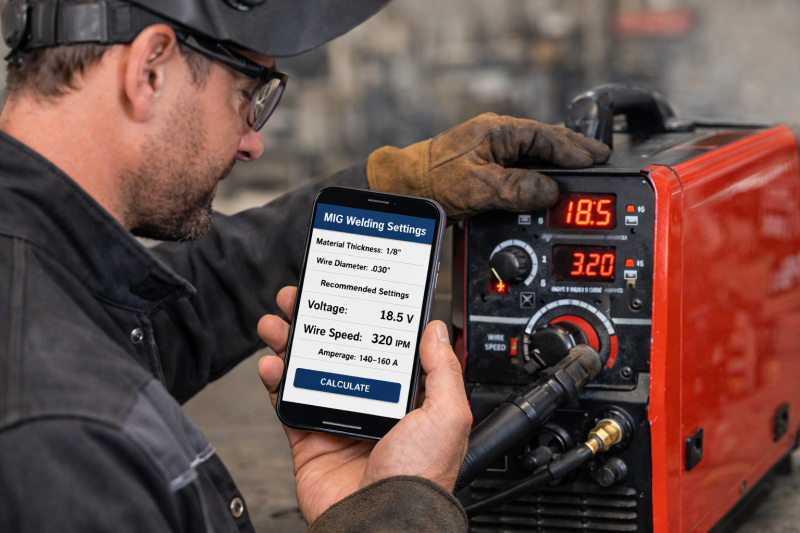
Many welders search for MIG welding settings when setting up a welding machine for a new project. Determining the correct voltage and wire speed is essential for producing strong, clean welds.
Incorrect settings can lead to poor penetration, excessive spatter, or weak welds. Instead of guessing or constantly adjusting your machine, understanding how MIG settings work allows you to produce consistent results.
In this guide, we will explain how MIG welding settings are determined, what factors affect them, and how welders can quickly calculate proper settings using modern tools like a welding settings calculator.
Written by Brent Mathurin
Why MIG Welding Settings Matter
MIG welding is widely used in fabrication shops because it is efficient, versatile, and relatively easy to learn. However, MIG welding requires the correct balance of parameters to produce quality welds.
The most important settings include:
-
Voltage
-
Wire feed speed
-
Amperage (which is influenced by wire speed)
-
Shielding gas
-
Material thickness
When these settings are incorrect, weld quality suffers.
Common problems caused by incorrect settings include:
-
Lack of penetration
-
Excessive spatter
-
Burn-through
-
Poor bead shape
-
Weak weld joints
Proper MIG welding settings ensure the weld penetrates correctly while maintaining a smooth and stable arc.
The Most Important MIG Welding Settings
Voltage
Voltage controls the arc length during welding.
Higher voltage creates a longer arc and wider bead. Lower voltage creates a shorter arc and narrower weld bead.
If voltage is too low:
-
the arc becomes unstable
-
the weld bead may pile up
If voltage is too high:
-
excessive spatter may occur
-
the bead may flatten excessively
Proper voltage creates a smooth arc with a consistent bead profile.
Wire Feed Speed
Wire feed speed determines how fast the welding wire feeds into the weld pool.
This setting directly affects amperage.
Increasing wire speed increases amperage and heat input. Decreasing wire speed lowers amperage.
If wire speed is too slow:
-
the arc may break
-
penetration will be poor
If wire speed is too fast:
-
the gun may push back
-
excessive buildup occurs
Proper wire speed creates a stable arc and steady weld puddle.
How Material Thickness Affects MIG Settings
One of the biggest factors affecting MIG welding parameters is material thickness.
Thicker metal requires:
-
higher amperage
-
higher wire feed speed
-
increased voltage
Thin materials require lower heat input to prevent burn-through.
Example guideline:
| Material Thickness | Approx Amperage |
|---|---|
| 1/16 inch | 30–90 amps |
| 1/8 inch | 90–150 amps |
| 1/4 inch | 150–250 amps |
These values vary depending on wire type and shielding gas.
Common MIG Welding Setting Mistakes
Even experienced welders sometimes make mistakes when setting up MIG machines.
Here are some common issues.
Guessing Settings
Many welders rely entirely on guesswork rather than structured calculations.
This can lead to inconsistent weld quality.
Ignoring Wire Diameter
Wire size significantly affects welding parameters.
Common MIG wire diameters include:
-
.023
-
.030
-
.035
-
.045
Larger wire requires more amperage and higher feed speed.
Incorrect Gas Settings
Shielding gas affects arc stability and penetration.
Common mixtures include:
-
75% Argon / 25% CO₂ for mild steel
-
100% Argon for aluminum
-
Argon/CO₂ blends for fabrication work
Gas selection influences welding performance.
Why Welders Use a Welding Settings Calculator
Calculating welding parameters manually can take time, especially when switching between materials and thicknesses.
A welding settings calculator simplifies the process by allowing welders to input material thickness and receive recommended settings instantly.
Using a digital welding calculator provides several advantages:
-
faster machine setup
-
more accurate welding parameters
-
consistent weld quality
-
reduced trial-and-error adjustments
For fabrication shops that handle many different projects, this can significantly improve workflow.
MIG Welding Settings App by Industrial Management Systems
Industrial Management Systems has developed a set of engineering apps designed for welders and fabricators.
One of the most useful tools is the MIG Welding Settings App, which helps determine proper welding parameters quickly.
The app allows welders to estimate:
-
recommended voltage ranges
-
wire feed speed
-
amperage estimates
-
settings based on material thickness
Instead of flipping through charts or guessing settings, welders can use the app to determine parameters instantly.
This is especially useful for:
-
fabrication shops
-
welding students
-
contractors working with multiple materials
-
mobile welding operations
Other Fabrication Calculators Available
In addition to the MIG welding calculator, Industrial Management Systems provides several other fabrication tools.
These include:
Welding Job Pricing App
Helps fabrication shops estimate welding project costs based on labor, materials, and fabrication variables.
TIG Welding Settings App
Provides recommended amperage ranges for TIG welding operations.
Plasma Cutting Settings App
Helps determine correct plasma cutting parameters for different material thicknesses.
Picket Spacing Calculator
Useful when fabricating railings or fences requiring precise spacing.
These tools simplify common fabrication calculations and improve workflow efficiency.
How Welding Calculators Improve Fabrication Efficiency
Using digital welding tools offers several advantages for fabrication businesses.
Faster Setup
Welders can determine machine settings quickly without manual calculations.
Improved Accuracy
Digital tools reduce human error and improve consistency.
Consistent Weld Quality
Standardized parameters help ensure repeatable results.
Better Project Planning
Cost calculators help fabrication shops estimate project pricing more accurately.
Final Thoughts
MIG welding settings are critical for producing strong, clean welds. Understanding how voltage, wire speed, and material thickness interact helps welders produce consistent results.
However, calculating welding parameters manually can be time-consuming and sometimes inaccurate.
Using a welding calculator allows welders to determine settings quickly and confidently, improving efficiency and weld quality.
Explore the Free Welding Calculators
Industrial Management Systems provides practical fabrication engineering apps designed for welders and metal fabricators.
These tools simplify welding calculations, fabrication measurements, and project pricing.
Explore the full collection here:
Add comment
Comments